

Case Study - Off-Grid in the Outback
Date:
November, 2025
Written by:
Christiane Partl
Published in:
Pip Magazine, Issue 38
In the far reaches of Western New South Wales, where red dust drifts across the horizon, on beautiful Wilyakali country, an abandoned homestead has been given a second life. Agricultural and environmental scientist Dr Anika Molesworth and her husband have transformed a run-down cottage into their forever home, a place of comfort, resilience, and connection to the land. By salvaging what they could, sourcing sustainable materials, and designing for both climate and place, they’ve created an off-grid eco-friendly home in Australia’s challenging outback.
A New Life for an Old Homestead
Anika and her husband had spent the last few years thinking about where they would build their forever home. Shocked by the cost of modular houses and building from scratch due of their remote location, they turned their attention to an abandoned homestead at the back of their 10,000 acre family property.
“It was a humble little cottage, no running water or power, corrugated iron, very small windows, very small rooms. But we used our imagination and thought about how we could strip it down and use it as the foundation for something larger, more modern, and open”, Anika recalls.
The couple saw an opportunity to create something different from bones of a building that had endured decades of harsh weather conditions. They saw a foundation that could be respected, preserved, and renewed.
Excited and ambitious, they decided to take on the challenge of turning a piece of Australian history into their forever home. For Anika, stripping the homestead back and keeping the same footprint meant less waste and less disturbance to the site than building something new.
Their vision wasn’t shared by several local builders who dismissed the idea outright. “We’d hear, ‘Just knock it down and start fresh.’ But that’s not how we wanted to approach it. We didn’t want cheap and fast, we wanted to build something that reflected our values.”
The decision to work with what was already there set the tone for the whole project. It meant embracing complexity and challenge rather than taking shortcuts. It meant committing to a long-term vision grounded in sustainability.
The build took around 12 months from when they started stripping out the old homestead to when they moved in. “We’re still doing tweaks but that’s fine because we’re here, we’re comfortable and we’ve built something we believe in.”
Designing for Place
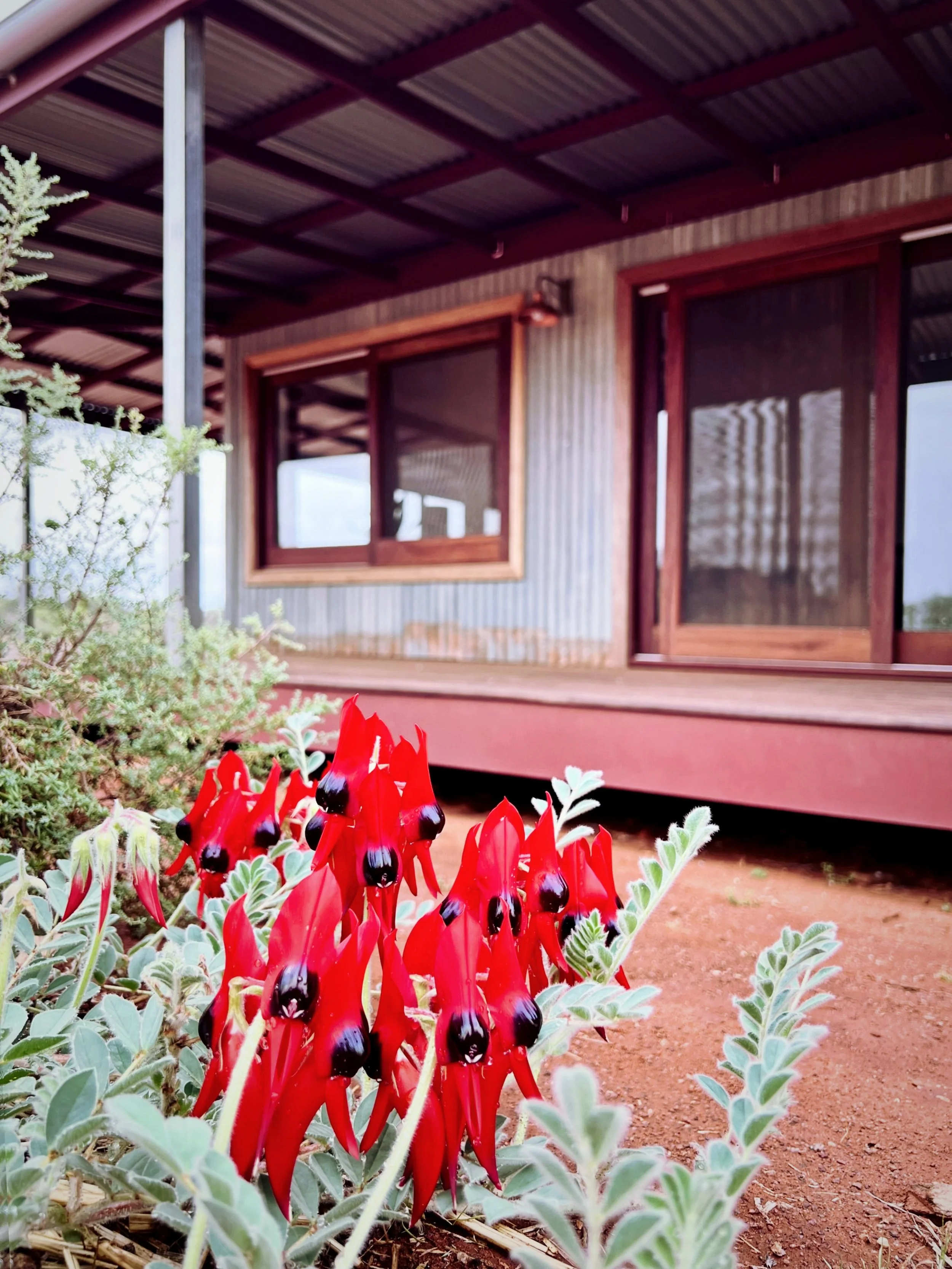
Living in the outback means designing for extremes, heatwaves, dust storms, and months without rain. For Anika and her husband it was important to create something that was not only beautiful and comfortable, but also planet-friendly. As an agricultural and environmental scientist with a PhD on climate change and its impact on food-producing environments and rural communities, Anika is very conscious of her footprint on the planet and wanted their home to be climate-smart, to perform well thermally, to last, and to make the most of natural systems like cross-ventilation and passive shading. Those values were central to this project.
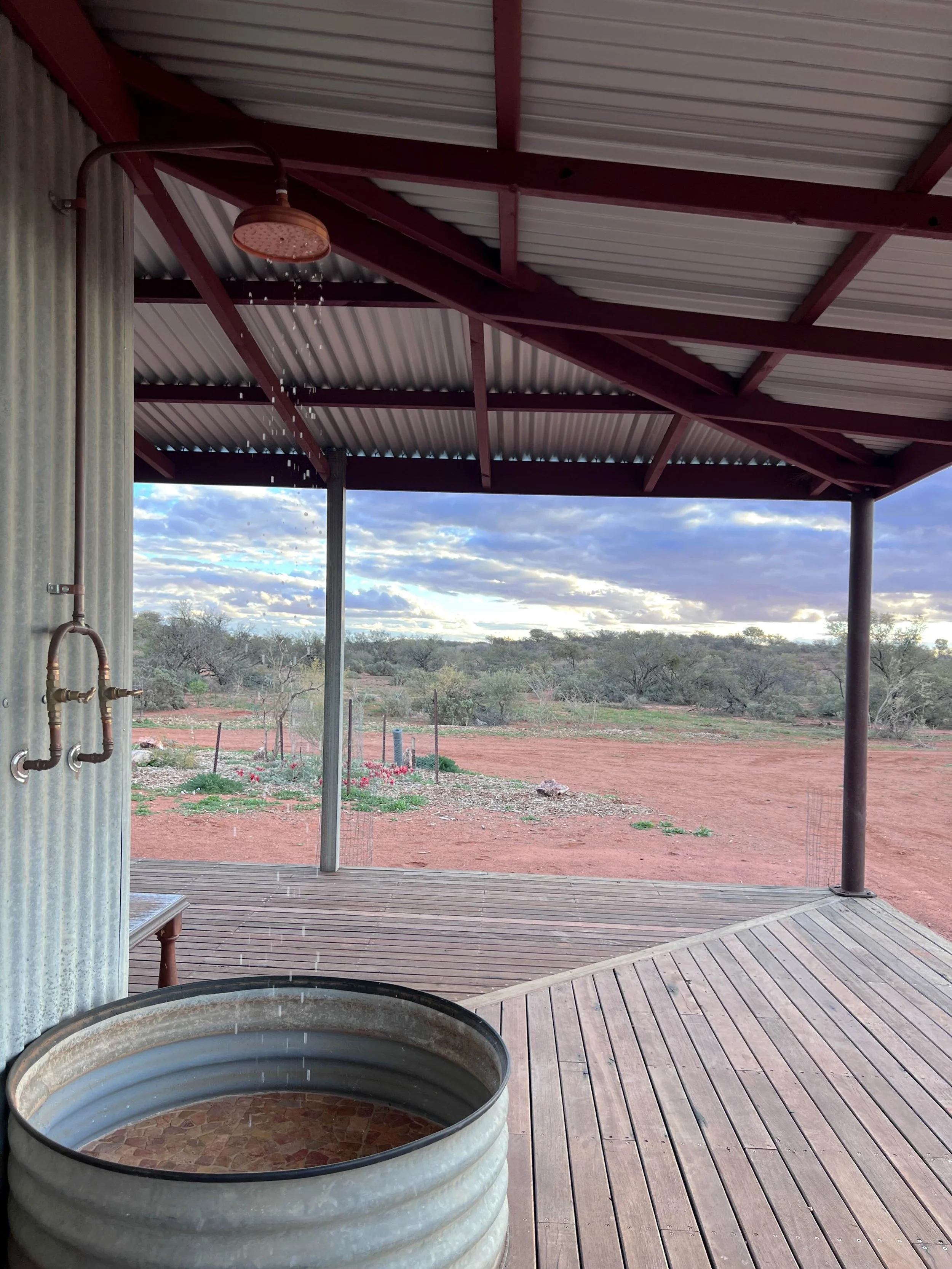
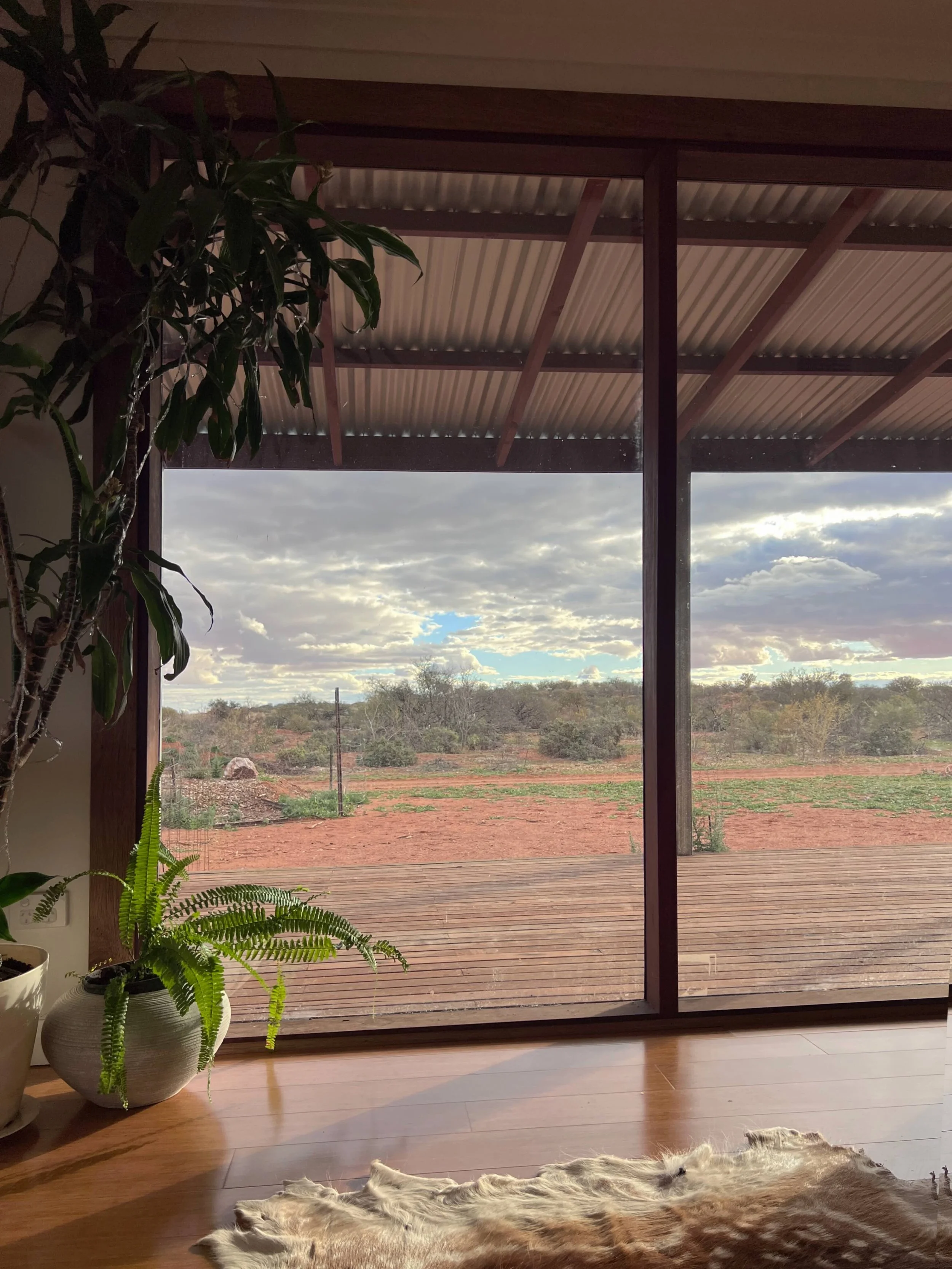
Deciding to keep the original concrete slab, was for them a symbolic way of honouring the old homestead’s place and mitigating the need to bulldoze the landscape. They added wide wrap-around verandas to provide additional shade, cooling the walls naturally while also extending the living areas outdoors.
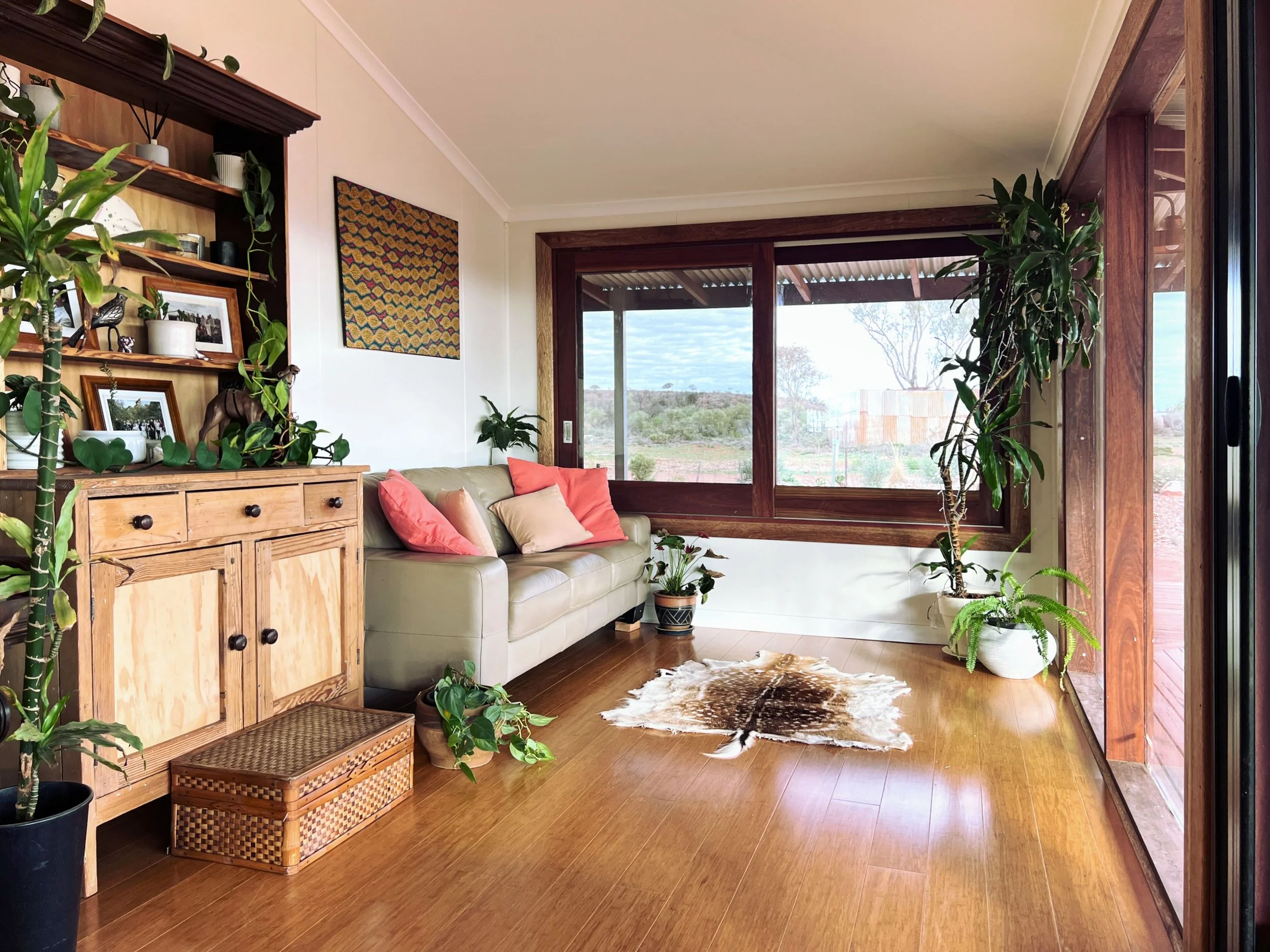
Their mornings are now spent with a coffee watching the horizon shift in the early light. From every window, there’s a sense of immersion in the landscape, the large openings allowing breezes to flow freely.
Finding the Right Builder and Sourcing Materials
After a long time spent trying to find the right person for the job, they eventually found a local building group who were open and willing to think differently. “They didn’t flinch when I started talking about straw walls, recycled materials, or solar power for electric vehicles,” Anika says.
“We realised early on that we had a choice: either throw our values out the window and do it the way most people do, cheap and easy, or stick to our values, even if that meant it would be tough. My husband and I talked about it and we knew that if we compromised, we wouldn’t be happy. We’d look at the house and feel disappointed. So we decided to stay true to what we care about, even if it wasn’t the easiest. At least we’ll be able to look around our home and say, ‘Wow, we've created something really special’ and that was our mission, to create a forever home that is comfortable and beautiful, but that doesn’t cost the planet.”
Even with the builder on board, sourcing materials meant thinking creatively and looking further than just what was available locally.
Situated near the remote town of Broken Hill, materials had to be sourced from considerably further afield, such as the recycled decking timber from Canberra or the windows and doors from Adelaide. Many of the local suppliers proving to be quite conservative, focused on the cheapest and easiest options, so they had to search for different choices. Anika explains, “For us it was about quality, durability, and choosing things that would last decades while having a lighter environmental impact.”
They managed a careful budget, choosing to spend where it mattered, such as on double-glazing, insulation, and a robust off-grid power system, while saving on elements they felt they could handle on their own. Designing the home themselves, they sketched plans that balanced ambition with practicality.
Straw, Timber, and Tin
Materials with a Story
Inside the Outback Climate Smart Home, there’s an immediate sense of calm and quiet. The internal walls have a soft, matte texture, absorbing sound and holding the day’s warmth. They’re built using Durra Panel, an innovative, eco-friendly building material made of an engineered biomass core entirely of reclaimed wheat straw. The unique panel core extrusion process requires no water, gas, additives, glues or chemical binders and produces zero toxic waste.
“It’s just compressed straw,” Anika says, still excited by the product and its simplicity. “Yet it’s fire-resistant, highly insulating, has great acoustics, is 100% recyclable and biodegradable, Australian-made and it provides a secondary income stream for cropping farmers. Instead of burning off the stubble, it’s harvested and pressed into panels for walls and ceilings. That was such a beautiful story in itself.” She adds, “The unique properties make it an ideal choice for creating a comfortable and safe living environment in the outback.”
The exterior tells its own story. Sheets of weathered corrugated iron, salvaged from the homestead’s original roof, now wrap the house in a silvery grey and deep rust patina. Far from flashy, the weathered looking cladding blends into the surrounding landscape, allowing the home to feel as though it belongs.
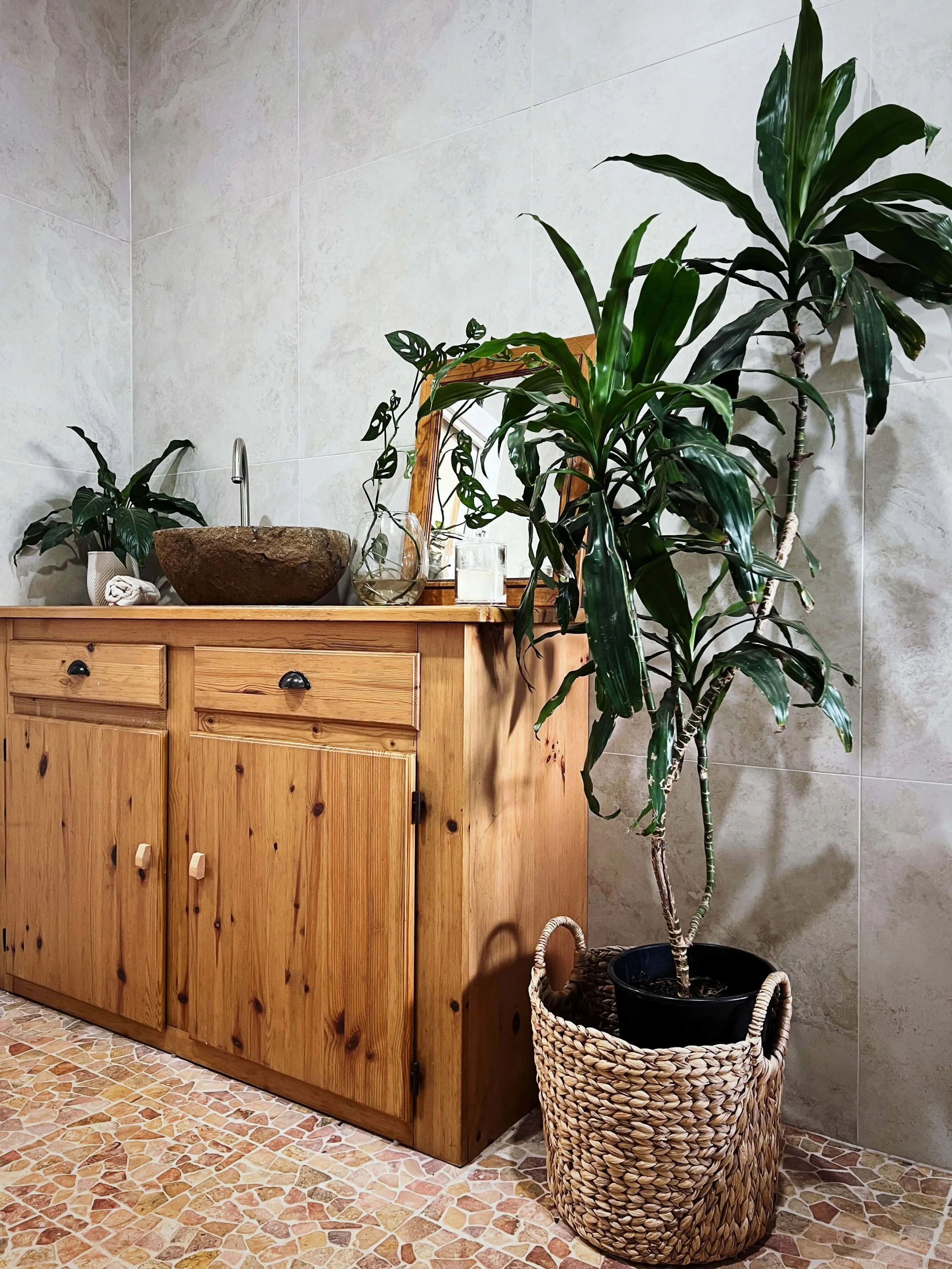
The exterior decking boards form a beautiful patchwork of reclaimed ironbark, once a part of churches, sports halls, and demolished homes. Inside, bamboo flooring brings a warm, golden glow that reflects light softly into the rooms. In the centre of their kitchen and dining area, surrounded by indoor plants is the old brick fireplace from the original homestead which they’ve lovingly restored.
In the kitchen and laundry, Eco Benchtops made from over 80% recycled glass reclaimed from Australian waste streams, provide a durable, silica-free surface. Another Australian-owned and made product, from the start to finish of their supply chain. “It’s beautiful, it’s functional, and it’s waste kept out of landfill, again, a perfect match for our values.” Anika says.
Every material chosen tells a story of care and respect for the environment, proving that sustainability doesn’t mean sacrificing quality or beauty.
Off-Grid Performance and the Long Game
When Anika and her husband told people they planned to be completely off-grid, including their two electric vehicles, people were sceptical. They told them it wouldn’t work, that they’d need a diesel generator but that just made them more determined to prove it could be done. “Now, when people visit, they’re genuinely curious and amazed. We set the house up as an example, if we can do it here, in one of the most remote places in the country, then anyone can.”
The home’s 20kW solar array and 30kWh battery, power everything: appliances, lighting, heating/cooling, and the electric vehicles; a small town car and a Polaris Electric buggy, ideal for navigating the rugged terrain on the property. All water comes from rainwater tanks, carefully filtered for household use.
This isn’t just about self-sufficiency, it’s about setting up a home to run affordably and reliably for decades to come.
“Connecting to the grid would have cost a fortune,” Anika explains. “Now we have no power bills, no water bills, and the systems are built to last. That’s the kind of investment that makes sense.”
“It’s all about the long game. This is our forever home. We might be here for 30, 40, 50 years. We want to love it, be proud of it, and not be saddled with never-ending expenses.”
This philosophy extends beyond energy and water. The garden is planted entirely with hardy native species that thrive with minimal watering and maintenance, sustained solely on recycled greywater.
“We’ve already seen bearded dragons, zebra finches, and red-capped robins move in. It’s beautiful to know the wildlife enjoys this place too and it’s a reminder that this home sits as part of the broader ecosystem.”
Inspiring better living
The Outback Climate Smart Home is not flashy or ostentatious. Its beauty lies in restraint, in materials chosen for their story and performance, in spaces shaped for climate and lifestyle and in the systems designed to work quietly and efficiently for decades.
“This home isn’t just a shelter,” Anika says. “It’s an embodiment of everything we care about. It’s possible to build in a way that’s conscious, creative, and forward-thinking. I want people to know that there are better ways to build, that you don’t have to sacrifice comfort or beauty to live lightly on the Earth.”
As the sun drops behind the distant ranges, the compressed straw panel walls hold the day’s warmth and this humble homestead has become a living example of resilience, comfort, and care for the planet in one of Australia’s remote and challenging landscapes.
Date:
November, 2025
Written by:
Christiane Partl
Photos by:
Anika Molesworth
Published in:
Pip Magazine, Issue 38